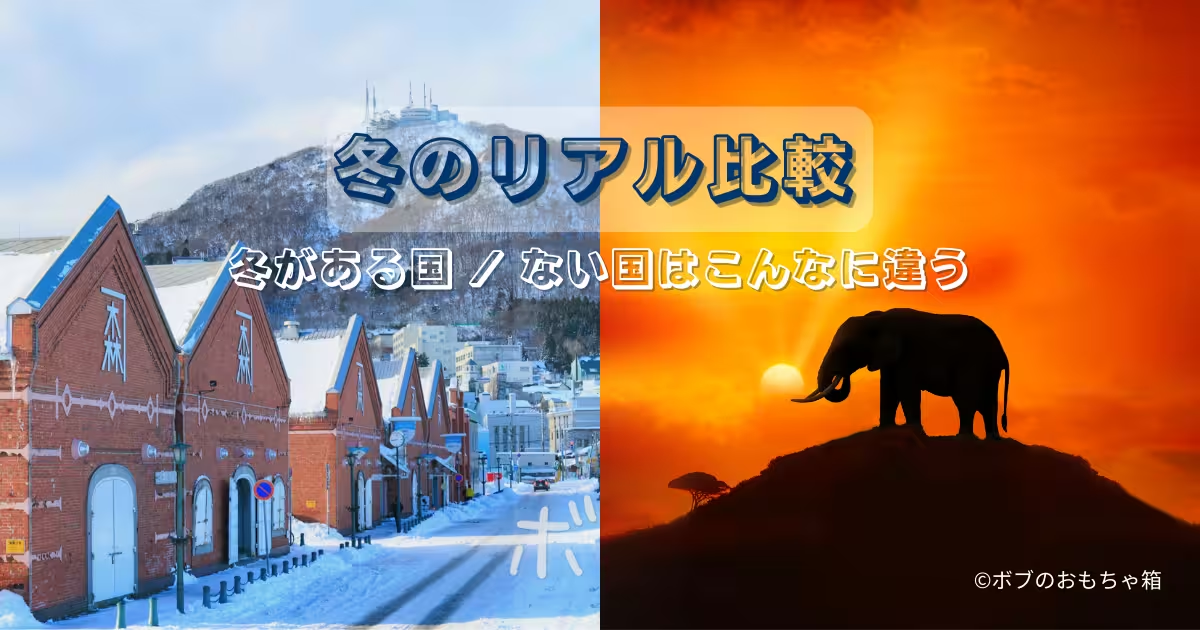
When people think of winter in Japan, images of cold air, kotatsu, hot pot, illuminations, and year-end traditions come to mind. But around the world, the idea that “winter = a cold season” doesn’t always apply.
When people think of winter in Japan, images of cold air, kotatsu, hot pot, illuminations, and year-end traditions come to mind. But around the world, the idea that “winter = a cold season” doesn’t always apply.
🔖 Why not save these differences in winter across countries so you can look back on them later?👇
On iPhone/iPad: Tap Share → Add to Home Screen You can save it here ✨
A “save-for-later memo” where you can always revisit winter comparisons around the world ⛄️📍
🇯🇵 Japan's Winter Characteristics|A Unique Season of Cold, Dryness, and Overlapping Events
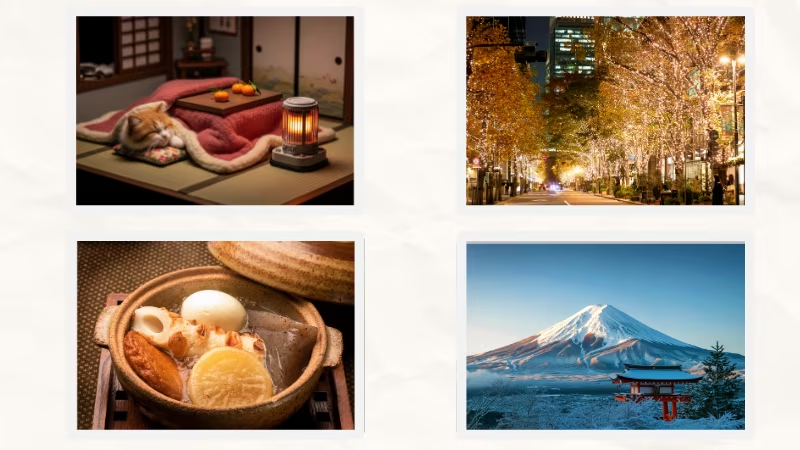
Winter in Japan is not merely a season of falling temperatures. Regional climate differences, lifestyles, and unique winter cultures all intertwine,“The Japanese Way of Experiencing Winter” has been shaped.
Here, we will examine Japan's winter from three symbolic perspectives.
Significant regional variations in winter cold
Winter in Japan, from north to southA completely different season unfoldsIt's characterized by such significant regional differences that one might even say it's almost like saying so.
In Hokkaido, once winter begins, a vast expanse of snowy landscapes stretches out for a long period. Temperatures dropping below freezing are commonplace, making warm down coats and boots essential. There are also unique winter hazards, such as black ice formed when partially melted snow refreezes.
On the other hand, in the Kanto region, snow rarely falls, and the defining feature of winter isDegree of DrynessThe air is so cold it makes your skin feel tight, and when the wind blows, it makes it feel even colder.
Some British people who have visited Kansai also shared these thoughts.
I don't like Osaka's winters because they're cold and it never snows.
Regions with snowfall have their own snow-related troubles, while regions without snow suffer from dryness and bone-chilling cold. Even within a single country, Japan's winter can be said to have ”two or three distinct types.”
Winter Traditions (Kotatsu, Hot Pot, New Year's)
What makes Japanese winters special is,Cold and culture are deeply intertwined.thing.
Returning home to the cold air, I first crawl under the kotatsu to warm up. That uniquely winter time spent eating mikan under the kotatsu is rarely seen overseas.
Seasonal meals hold their own unique charm. Steaming hot pot dishes, oden stew, piping hot soup. Precisely because it's cold outside, the time spent gathered around warm meals indoors holds special value.
Furthermore, Japanese winters areThe event density is among the highest in the world
- Christmas Illuminations
- The stillness of New Year's Eve
- New Year's Eve Bell
- First shrine visit of the year
- New Year's cuisine
- Lucky Bag
To people overseas, Japanese winters are not a "culture to distract from the cold,"A country with many events designed to enjoy winter itselfIt seems to be reflected as.
Heating Systems: A Major Difference from Overseas
A common complaint about Japanese winters is the problem of cold houses.
In cold regions like Sweden and the UK, central heating that warms the entire house is common. Temperature differences between rooms are minimal, and no matter how cold it is outside, the indoors remain comfortably warm.
However, in Japan, the primary heating method is ”partial heating” using air conditioners or stoves.
Therefore,
- There are temperature differences between rooms.
- The hallway and changing room are extremely cold.
- Your breath turns white indoors
Such things are not uncommon.
People from overseas often say things like this.
"Japanese houses are colder than outside."
HeatTech is a must for winter travel in Japan.
This is Japanese housing.Not strongly considering thermal insulationThis stems from its long history. While improvements have been made in recent years, the gap compared to other countries remains significant.
In this way, Japanese winters are not just about the ”cold outside,”A country where coping with the cold indoors has become a cultural normIt could also be said.
Winter in ”Warm Countries”|Comfortable Season Edition (Qatar, South Africa, etc.)
In Japan, winter is strongly associated with cold weather, but around the world,“Winter is actually the most comfortable season.”There exists a country.
In such countries, winter brings no trace of cold, with a climate akin to Japan's spring or early summer spreading across the land, brightening the atmosphere of the streets. In regions where the heat is too intense, winter becomes the ”season to go out and enjoy,” also marking the peak season for events and tourism.
Here, suchA prime example of a country where winter is comfortableWe introduce winter in Qatar in the Middle East and South Africa in the Southern Hemisphere. Both countries reveal a ”seasonal perspective” that is completely different from Japan's winter.
🇶🇦 Qatar|Winter = 26°C, the most comfortable season of the year
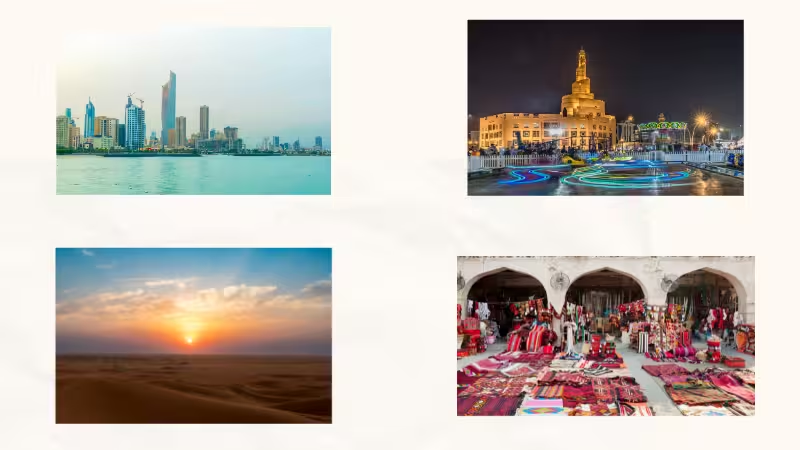
Qatar's "winter" is the best season to escape the heat. Daytime temperatures are Around 25–26°C And the comfort of a Japanese spring.
A friend working in Qatar says this.
Winter is the best season of the year. Finally, I can live outdoors.
The reason is clear,In summer, it's already 40°C at 7 a.m., and 50°C by noon. Because it's so harsh it reaches that point. Precisely because I know that daily reality, winter is like a season of ”rest for the soul.”
There is no Christmas culture,New Year's Eve fireworks are spectacular, and winter is the peak tourist season.Here, you'll find a warm and comfortable winter—the complete opposite of Japan's freezing cold.
🇿🇦 South Africa|It's the height of summer now. A country where the climate varies greatly by region.
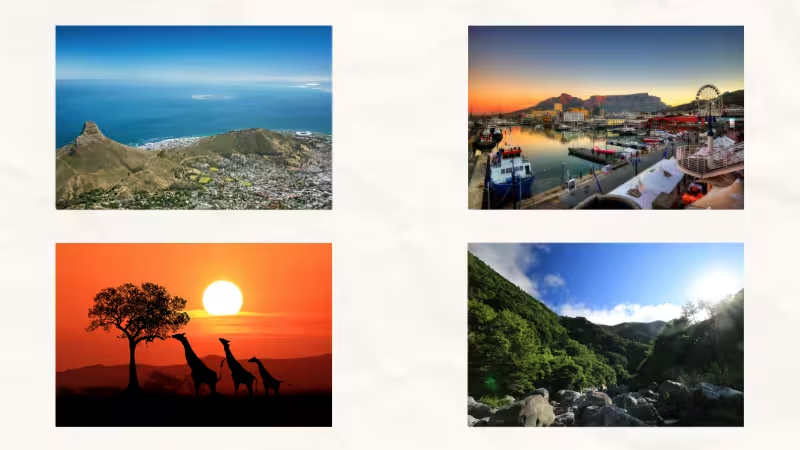
South Africa has opposite seasons to Japan, with December being the height of summer. However, due to its vast land area,“South Africa's summer” also has two sides.
One is the Cape Town side, where dry air prevails.
The other is the eastern coast (Durban) side, where humidity is high and squall-like rains fall.
A defining feature is that even within the same country, the climate can be completely different.
Below, we introduce the ”summer and winter landscapes” of South Africa while organizing them.
- ■ Cape Town: Dry and 30°C, wildfires also occur
-
Cape Town's summers are very dry, with crisp, comfortable air, whileClimate prone to firesfor Halloween nights.
A friend who actually lives in Cape Town told me this.
- Summer is extremely dry.
- The more often fire alarms go off,
- The air is crisp and dry, the complete opposite of Japan's humidity.
The wind sweeps across the parched land, revealing a landscape that epitomizes an African summer.
- ■ Durban (East Coast): High humidity and frequent rainfall
-
Even within South Africa, Durban on the east coast is a completely different world. It's humid, with high rainfall,An environment close to a tropical climateis a characteristic feature.
"Cape Town feels like a completely different country," as South Africans themselves say.
The dry air spreading across the west and the humid, green east seem to experience ”different seasons” even during the same period.
- ■ Winter (June–August) shows significant regional variation
-
Winter in South Africa arrives from June to August, and this winter too,Completely different faces depending on the regionwill be shown.
- Cold regions: A proper coat is essential for that ”wintery feel.”
- Warm regions: Similar to autumn in Japan, with comfortable daytime temperatures.
- Overall, the impression is strongly that it is warmer than Japan.
And what's interesting is,“The culture of celebrating Christmas in the middle of summer remains firmly intact today.thing.
My friend from South Africa told me this.
Christmas Eve, Christmas Day, Boxing Day... I'll celebrate them all!
Boxing Day is the holiday the day after Christmas.
That day is a holiday for everyone, and it's also a day to watch cricket.
I go to the stadium to watch games or watch them on TV at home.Boxing Day, which isn't very familiar in Japan, isA public holiday widely celebrated in the United Kingdom and Commonwealth countries.
Originally, the tradition began on the day after Christmas when ”churches opened donation boxes and distributed the contents to those in need.” Today, it has become established as a day spent with family and a day for exchanging gifts.
This tradition is also deeply rooted in South Africa, with Christmas Eve, Christmas Day, and Boxing Day.The celebratory mood continues for three days straight.is its defining feature. Moreover, that In the heat of summer, with temperatures nearing 30°CSince it takes place in summer, the scenery is completely different from Japan, where Christmas is celebrated in the cold winter.
- Outdoor barbecue
- Dining on the terrace
- Christmas at the Beach
- Watching cricket with family
This ”summer Christmas” is a charm unique to South Africa.
Even if the seasons are different,The fundamental desire to spend time with loved ones is universal.Somehow, it's just wonderful.
Winters in countries where winter is truly cold|Countries rich in darkness, snow, and culture (Sweden, Hungary, etc.)
On the other hand, there are countries where winter is harsh, enveloped in genuine cold and darkness. Here we introduce life in countries with ”proper winters,” such as Sweden in Northern Europe and Hungary in Central Europe.
🇸🇪 Sweden|Sunset at 3 PM. Living for the light in the Nordic winter
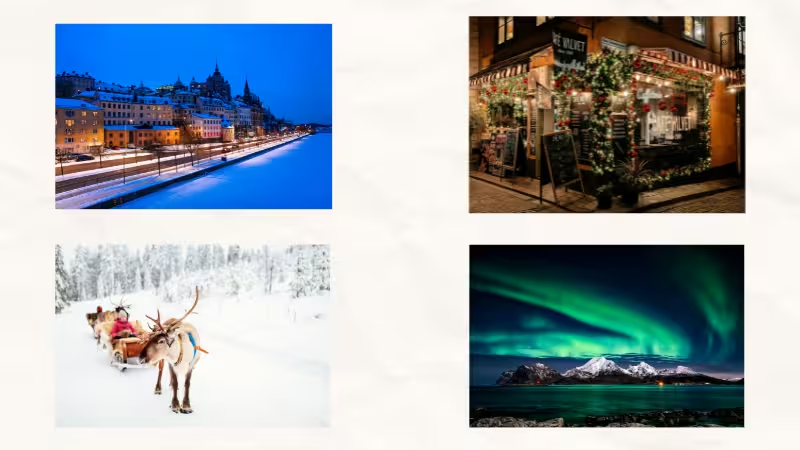
Swedish winters are more about the darkness than the cold.“The Sun's Shortness”I hear it's tough. By 3 PM, the sun sets, and the town quickly takes on a nighttime atmosphere.
A Swedish person said this.
Winter days are so short that I find myself chasing the sun with my eyes. I just want to soak up every bit of light I can.
The emphasis on warm lighting and interior design in Nordic homes stems largely from this environment. The art of lighting indoors has become a cultural practice that sustains life during winter.
🇬🇧 United Kingdom|Winters are long. There is little sunlight, and winter lasts several months longer than in Tokyo.
Winter in the UK lasts longer than in Japan,Late November to AprilA long battle.
Temperatures are low, and "The coldest day in Tokyo is about as cold as an ”average” winter day in the UK."Some say..."
European-style Christmas is incredibly charming, with the entire town transforming into a ”winter festival” where you can enjoy Christmas markets with a glass of mulled wine in hand and stroll past rows of craft stalls.
🇭🇺 Hungary|A winter that's cold but sees little snow. The country of Christmas, where the entire town is bathed in light.
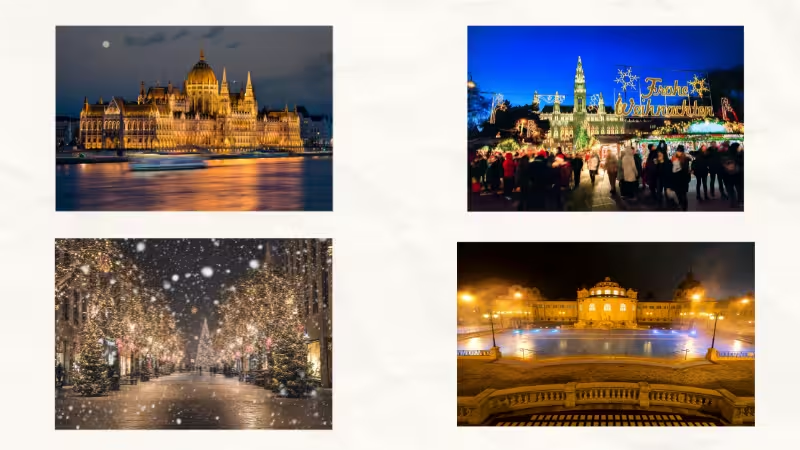
Hungarian winters, like those in Japan, are a season when you really feel the cold, but surprisingly...Snow doesn't fall much; drizzly rain is common.is a characteristic feature.
That said, winter in Hungary is often described as ”a season where warmth glows within the cold,” and the city's atmosphere has a certain romantic quality. Especially once December arrives, the air in the city transforms completely.
A Hungarian person told me this.
Christmas Eve is December 24th. Students and adults alike have school or work until December 22nd.
In big cities, the central square gets lit up, and even the streets are decorated with illuminations.
"There's an Advent market too, and my town's market is really famous."
The city center is adorned with arches of light, and the illuminations spreading down the streets look like a scene straight out of a movie. At the Christmas market, stalls line up with trinkets, mulled wine, and adorable handmade ornaments, and the winter chill only heightens the excitement of the event.
What's even more impressive is that,The Richness of Traditional Cuisine
- Harasley (Fish Soup)
- Roast Duck
- Pörkölt (Hungarian stew)
- Home-style cooking served with rice or mashed potatoes
- Gingerbread Cookies
- Bayguri (beautiful swirl-patterned rolled confection)
Among them, ”bagly” is a confection that symbolizes Hungarian winters. It's a traditional sweet, both visually and in taste, that's rich and festive, made by rolling poppy seed or walnut paste into dough and baking it.
“Though it is a winter with little snow, the warmth of the city lights, the markets, and home-cooked meals all combine, making Hungarian winters feel like a gentle passage of time.
🇺🇸 American Winter|The ”Scale of the Country” with Huge Regional Differences and Christmas Culture
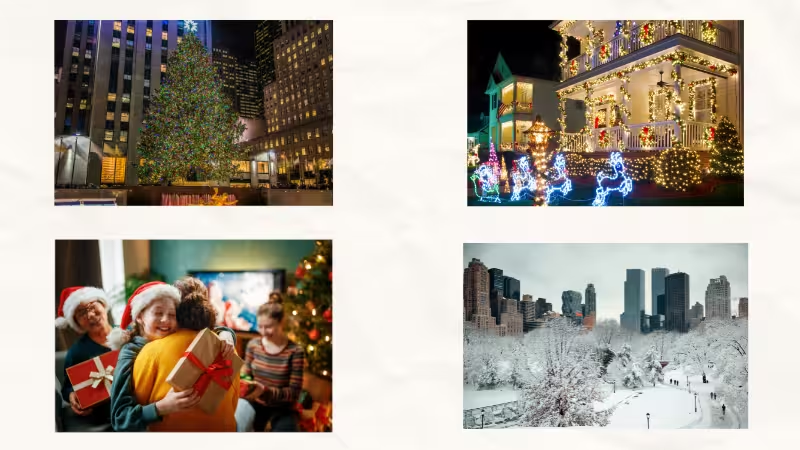
When discussing American winters, the first thing to understand isThe regional differences are simply enormous.Within the same country, there are cities where snow rarely falls, while other regions are inevitably blanketed by blizzards every year.
For example, in San Francisco, California, snow rarely falls, and even in winter, the climate resembles a ”chilly autumn.”
A friend who lives in San Francisco says this.
"San Francisco gets cold in winter, but it rarely snows."
Meanwhile, on the East Coast in places like New York and Michigan, it's not uncommon for snow to accumulate and sub-freezing temperatures to persist. ThisThe sheer size of the country directly translates to significant seasonal differences.This is a characteristic feature of winter unique to America.
Christmas culture is overwhelmingly dominant
What symbolizes American winter more than anything else isChristmas
Its presence is incomparable to Japan's,Winter = Christmas season You could say that. Come December, the city is instantly enveloped in holiday spirit.
- Private homes go all out with their holiday lighting displays.
- Light shows are held in some areas.
- Many households decorate with a huge real fir tree.
- Giant Christmas trees appear in shopping malls and town squares
Christmas decorating is a family tradition, and some areas even hold decoration contests where people compete to see whose house looks best.
For Americans, Christmas is not just an event,A day symbolizing family, tradition, and communityThe strength of this culture defines the image of winter in America.
New Year's is a time for family togetherness.
Compared to Japan, New Year's in America is somewhat quieter.
Rather than the extravagance of the festivities, it is positioned as the warm time spent with family that continues from Christmas.
- Enjoy movies and games with family and friends
- Relaxing at home
- Watch the countdown on TV
- Some areas have a few fireworks displays.
Such as these,A peaceful and gentle New Year's EveThis is characteristic of America. It's a quiet way to end winter, contrasting with the bustle of Christmas.
🇮🇳 India's winter, where regions with winter and regions without winter coexist
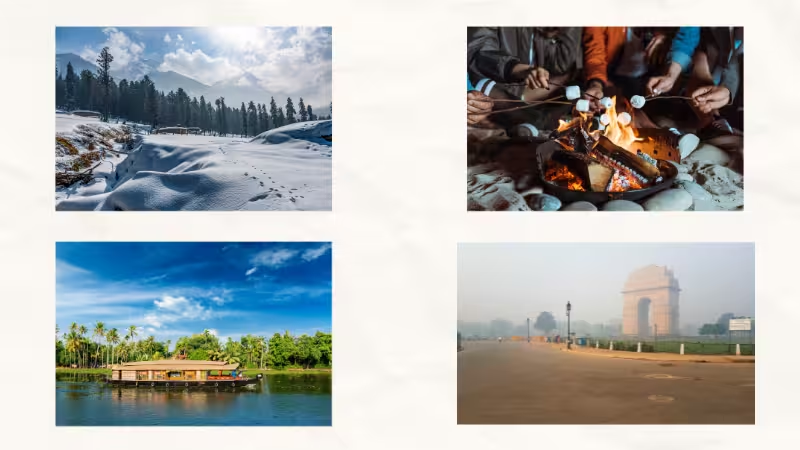
Indian winters are, above all,There are significant regional differences.It is characterized by its vast size. Not only is the country large, but due to differences in terrain and elevation, it is also a nation where completely different winters unfold, even during the same season.
Heading north, the scenery changes dramatically; heading south, the very concept of winter fades away. This diversity of winter is what makes India uniquely Indian.
Northern India is in the depths of winter, while the south enjoys near-perpetual summer.
Winter in India is not ”one winter,”Multiple winters exist simultaneously.Something like that.
- Northern India (Mountainous Regions): The real winter arrives
-
In the northern mountainous regions near the Himalayas,Snow is falling steadily.Winter arrives in earnest. Temperatures drop below freezing in some areas, surprising many people who exclaim, "It snows in India too!?"
In the mountain village, fog often settles, and the outside air can turn bitterly cold, stinging the skin.
- Northern Region (around Delhi): Properly cold
-
Even in the north, including the capital Delhi,Winter in Japan brings a solid cold like autumn to early winter.There are also those who say, "When winter comes, the morning fog grows thick. It's pleasantly cool outside."
While India is often thought of as a ”hot country,” the northern regions actually experience proper winters.
- South India: Where winter does not exist
-
On the other hand, South India isAlmost always summerEven in winter, temperatures don't drop much, and it's not uncommon to find regions where you don't feel the winter chill.
Even though it's the same season, the definition of winter varies across the country.This very diversity of climate is the very essence of India.
How to Spend Winter (Interesting Culture)
Indian winter culture is more about the cold itself thanHow to enjoy winter warmlyis focused on.
- Eat plenty of foods that warm the body
-
In India, when winter comes,Foods with warming propertiesoften appears on the dinner table.
- Cinnamon
- Ginger
- Dried fruit
- Clarified butter
- Nuts
- Warm Chai (Spiced Milk Tea)
Chai is especially emblematic of winter, its spice aroma and warmth spreading gently from within, truly embodying the ”taste of Indian winter.”
- The Culture of Gathering Around a Campfire
-
In some regions, there is a culture of gathering around bonfires with family and friends during winter. Time spent warming oneself by the fire against the cold night breeze, enjoying chai and snacks while chatting and laughing, is deeply cherished.
According to the Indian person I interviewed, ”I like winter in any country.” This struck me as a distinctly Indian perspective—one that values the human connection fostered by winter rather than the cold itself.
The Image of ”Japanese Winter” Painted by Countries Without Winter (Philippines, Indonesia)
There are countries in the world where the season of "winter" itself does not exist.
For a country where temperatures remain high year-round, snow rarely falls, and the concept of ”four seasons” is faint, Japan's winter feels like a completely different world.
This time,The ”image of Japanese winter” held by people in the Philippines and Indonesia”I listened to them. The actual voices were all more refreshing, warm, and romantic than Japanese people imagine.
🇵🇭🇮🇩 Philippines & Indonesia | Japan's Winter Seen from Countries Without Winter
Both the Philippines and Indonesia are essentially tropical countries. Their seasons consist of just two: the dry season and the rainy season. There is no concept of winter. That's precisely why, when it comes to Japanese winters,A fantastical season unlike any I've ever experiencedThis perspective is very strong.
From the interviews, a strong longing for winter phenomena like snow and illuminations was evident.
- Snow is a symbol of longing.”
-
"I'd like to see snow someday."
"Japan in a snowy landscape is like a dream."
and,Snow = an image of romanceis overwhelming. - The illuminations are as beautiful as a dream.
-
In countries without winter, the culture of illuminating entire towns is less common, so people tend to have a strong fascination with the illuminations seen in Japan and South Korea.
- “The kotatsu is a charming and fascinating cultural phenomenon.
-
Kotatsu culture seems incredibly strange and fascinating to people overseas, with many reacting with "I want to try getting under one too!" or "Is there furniture like this?"
- Only in eastern Indonesia is snowfall exceptional.”
-
While snow does fall in some mountainous regions of Indonesia, across the country as a whole, it is stillWinter does not exist.This is the general understanding.
That is precisely why Japanese winters appear as a season of the extraordinary.
Why Japan is more strongly associated with ”spring and autumn” than with winter
What was surprising was that the seasonal image of Japan held by people in the Philippines and IndonesiaSpring and autumn are overwhelmingly stronger than winter. That's the situation. The reason is clear.
✔️Cherry blossoms and autumn leaves are global icons.
The image of "Japan = Land of Cherry Blossoms" and "Japan = Land of Autumn Foliage" is extremely strong overseas. The Japanese landscapes most frequently shared on social media are overwhelmingly dominated by cherry blossoms and autumn foliage.
It's interesting to note that some people said, "When you think of Japan, you think of spring or autumn. Winter isn't much different from other countries."
Perhaps precisely because it's a country without winter, it's conversely difficult to imagine Japanese winters.
Comparing Winters Around the World Revealed Differences in Lifestyle
We've examined climate, culture, and events so far, but the fundamental difference in winter boils down to "how people live." Finally, let's organize the differences in winter from the perspective of lifestyle.
Differences in Heating Culture (Central vs. Japanese-Style)
In cold regions overseas, they heat the entire house. Central heating It's common. Therefore, no matter how cold it is outside,The interior is always warm and comfortable.
On the other hand, in Japan, ”partial heating” using air conditioners and stoves is the norm, which is why people often say, "Japanese homes are cold."
- Temperature differences between rooms
- Extreme cold in hallways and changing rooms
- Your breath turns white indoors
This situation is a characteristic feature of winter unique to Japan.
Cultural Differences in How We Enjoy Winter
How people enjoy winter also varies from country to country.
- Nordic Countries: A Culture That Treasures Light
It is precisely because winter is dark that lighting, candles, and indoor decor take on greater importance. - United States: Christmas-centered
Light displays, trees, and family time symbolize winter. - India: Campfire Culture
Winter is the season for gathering around the fire, a time cherished for warming both body and soul. - Qatar: Winter is the perfect season for outdoor activities
The weather became comfortable, with temperatures around 25–26°C.
Winter becomes the most active season of the year.
Looking around the world,The very meaning of winter differs from country to country.I understand that very well.
Summary|”Winter” isn't universal. Japan's winter is very unique.
Having seen winters around the world so far, what I feel is that“Winter is not a universal phenomenon, but a culture in itself.”That's the thing. The types of cold, the amount of sunlight, how people enjoy it, and even the "image of winter in countries without winter" are completely different.
Learning about winters in such countries makes Japan's winter charm—the dry, cold air, kotatsu, illuminations, the quiet of the year-end and New Year holidays, snowy landscapes—feel all the more special.
Winter is not universal.
That's precisely why Japanese winters are uniquely fascinating when you compare them.
I hope this winter comparison provides a fresh perspective for enjoying Japan's winter. We also have articles comparing autumns around the world, so if you're interested, please enjoy those as well. You can view the autumn comparisons via the related article links below.
Related Articles
- 🌍🍁 Are There Countries Without Autumn? - A Clear Guide to Seasonal Differences Around the World
- 🎄 Best Christmas Songs to Listen to in 2025 - A Holiday Playlist to Set the Mood
- 🎬 Christmas Movie Guide 2025 - 15 Heartwarming New and Classic Holiday Favorites

《 On iPhone / iPad, Tap Share → Add to Home Screen 》
A “Winter Pocket Dictionary” where you can instantly look up climate comparisons and cultural differences 📘
📍Perfect for travel, study abroad, and trivia research🌍✨
※The information on this page is based on research and interviews conducted as of December 2025. Climate and event dates are subject to change; please check with local tourism bureaus or official announcements for the latest information.